
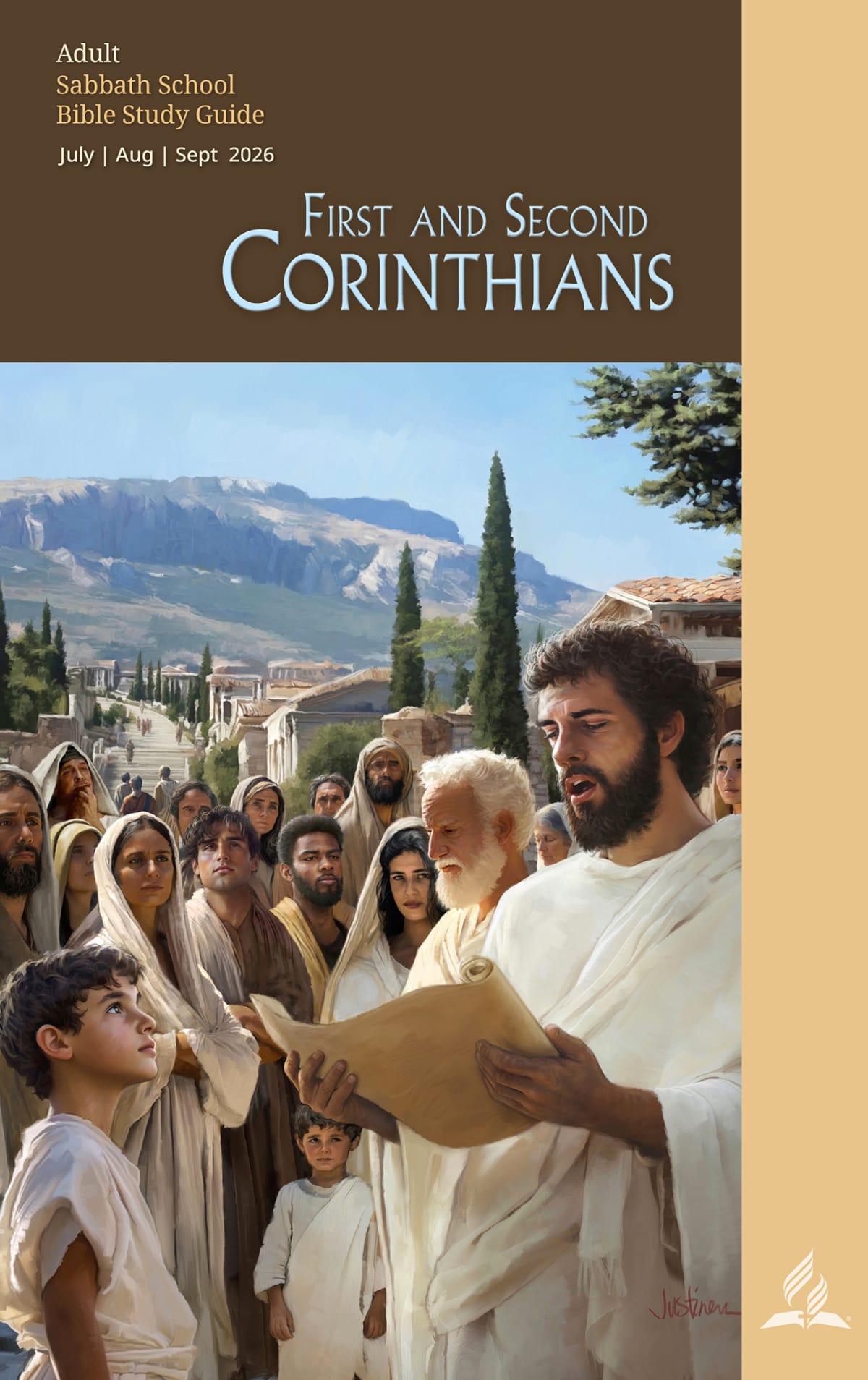
First and Second Corinthians (3rd Quarter 2026)

First and Second Corinthians (3rd Quarter 2026)
This quarter, we will explore Paul's letters to the Corinthians, discovering how the gospel of Jesus Christ and Him crucified is the foundation of Christian life, unity, mission, and witness. Written to a church facing division, immorality, false teachings, and spiritual challenges, these letters reveal that every problem is ultimately answered by the transforming power of Christ.
As we journey through each lesson, we will examine themes such as the message of the Cross, unity in Christ, holiness, spiritual gifts, Christian love, stewardship, resurrection, authentic ministry, and God's grace. Paul's counsel reminds us that the gospel is not only the message we believe but also the standard by which we live, serve, and relate to one another.
Throughout this quarter, let us prayerfully study God's Word together, allowing the Holy Spirit to deepen our faith, strengthen our fellowship, and prepare us to faithfully share the everlasting gospel as we await the soon return of Jesus Christ.
13 Weekly Lessons
8 LessonsThe Power of Christ’s Resurrection
"And if Christ is not risen, then our preaching is empty and your faith is also empty. . . . And if Christ is not risen, your faith is futile; you are still in your sins!"
Introduction & Study Notes
Lesson 8: The Power of Christ's Resurrection
(1 Corinthians 15 | August 15–21)
Introduction
The resurrection of Jesus Christ is the foundation of the Christian faith. Without it, Christianity has no hope, no forgiveness, and no future. Paul dedicates the entire chapter of 1 Corinthians 15 to defending the reality and importance of Christ's resurrection because some believers in Corinth had begun to deny the resurrection of the dead.
Paul explains that Christ's resurrection is not only a historical event but also the guarantee of our own resurrection when He returns. Because Jesus conquered death, believers can face the future with confidence and hope.
Sunday: Proclaiming the Resurrection of Christ
Key Text: 1 Corinthians 15:1–11
Paul begins by reminding the Corinthians of the gospel he had preached to them. This gospel consists of four essential truths:
Christ died for our sins.
He was buried.
He rose again on the third day.
He appeared to many witnesses.
These events happened "according to the Scriptures," showing that Jesus fulfilled the prophecies of the Old Testament.
Paul emphasizes that Christ's resurrection was witnessed by many people, including:
Peter
The Twelve disciples
More than 500 believers at one time
James
All the apostles
Paul himself
Many of these witnesses were still alive when Paul wrote, making it possible for others to verify the testimony.
Life Application
Our faith is based on historical evidence, not myths or legends. The resurrection assures us that Jesus truly is the Son of God and our Savior.
Monday: The Risen Christ—Our Only Hope
Key Text: 1 Corinthians 15:12–19
Paul addresses those who denied the resurrection by explaining the consequences if Christ had not risen.
If Christ is not raised:
preaching is useless.
faith is empty.
the apostles are false witnesses.
believers remain in their sins.
those who have died in Christ have perished.
Christians are the most miserable people because their hope is false.
Without the resurrection, Jesus' death would not have accomplished salvation. The cross and the empty tomb cannot be separated.
Paul argues that because Christ lives, our sins are forgiven and eternal life is guaranteed.
Life Application
The resurrection transforms Christianity from a philosophy into the living hope of salvation.
Tuesday: Christ, the Firstfruits
Key Text: 1 Corinthians 15:20–34
Paul now moves from the consequences of denying the resurrection to its certainty.
He declares:
"But now Christ is risen from the dead, and has become the firstfruits of those who have fallen asleep."
The term firstfruits comes from the Old Testament harvest festival. The first sheaf offered to God represented the coming harvest and guaranteed that the rest would follow.
Likewise:
Christ's resurrection is the first.
The resurrection of believers will follow when He returns.
Paul compares Adam and Christ:
Through Adam came sin and death.
Through Christ come righteousness and life.
Just as death entered the world through one man, resurrection comes through another.
Paul also explains that baptism symbolizes our union with Christ's death and resurrection (Romans 6:3–4; Colossians 2:12), reminding believers that the Christian life is centered on the hope of resurrection.
Life Application
Because Christ conquered death, believers need not fear the grave. His resurrection guarantees ours.
Wednesday: The Resurrected Body
Key Text: 1 Corinthians 15:35–49
Some questioned how the dead could possibly be raised.
Paul answers with three illustrations.
The seed
A seed must be buried before new life appears. Likewise, the body placed in the grave will be raised by God's power in a new and glorious form.
Different kinds of bodies
God has already created different bodies for humans, animals, birds, and fish. If He can create such diversity, He can certainly provide glorified bodies for His redeemed people.
Heavenly glory
The sun, moon, and stars each possess different glory. Similarly, the resurrected body will possess a glory far greater than our present earthly body.
Paul contrasts the two bodies.
Present BodyResurrected BodyPerishableImperishableDishonoredGloriousWeakPowerfulNaturalSpiritual
A spiritual body does not mean an immaterial spirit. Rather, it is a real body perfectly transformed and completely directed by the Holy Spirit.
Life Application
Physical weakness, sickness, aging, and death are temporary. God promises believers a perfect, immortal body.
Thursday: Final Victory Over Death
Key Text: 1 Corinthians 15:50–58
Paul explains that our present sinful bodies cannot inherit God's eternal kingdom. Therefore, a miraculous transformation must occur when Jesus returns.
At Christ's second coming:
the dead in Christ will be raised.
living believers will be changed instantly.
mortality will become immortality.
corruption will become incorruption.
Then Paul's triumphant words will be fulfilled:
"Death is swallowed up in victory."
Because of Christ:
death has lost its sting.
the grave has lost its victory.
eternal life belongs to God's people.
Paul concludes with encouragement:
"Therefore... be steadfast, immovable, always abounding in the work of the Lord, knowing that your labor is not in vain."
Our hope in the resurrection motivates faithful Christian living today.
Life Application
Every sacrifice made for Christ has eternal value because death is not the end of the believer's story.
Friday: Further Thought
Ellen G. White explains that Christ's resurrection assures believers of their own resurrection. The raising of Lazarus pointed forward to the resurrection of all the righteous at Christ's second coming.
She also vividly describes that glorious day when the righteous dead will rise in immortal bodies, reunited forever with loved ones, never to experience pain, sickness, or death again.
The resurrection is therefore not merely a doctrine but the Christian's greatest hope.
Key Lessons
The resurrection is the foundation of the gospel.
Christ's resurrection proves His victory over sin and death.
Without the resurrection, Christianity would be meaningless.
Jesus is the firstfruits, guaranteeing the future resurrection of believers.
Believers will receive glorified, immortal bodies at Christ's return.
Death is only a temporary sleep for those who belong to Christ.
The certainty of resurrection gives believers courage, hope, and purpose.
Discussion Questions
Why is the resurrection essential to the Christian faith?
What evidence does Paul give for Christ's resurrection?
What does it mean that Christ is the "firstfruits" of those who have died?
How does the promise of a glorified body encourage believers facing illness or aging?
How should the hope of resurrection influence the way Christians live today?
Conclusion
The resurrection of Jesus Christ is the cornerstone of Christianity. It confirms that His sacrifice on the cross was accepted by God, guarantees the forgiveness of sins, and assures believers of eternal life. Because Christ lives, death is not the end but a temporary sleep until His return. The promise of resurrection gives Christians confidence to endure suffering, remain faithful, and serve God with hope, knowing that one day they will be raised in glory to live with Christ forever.
